Showing posts with label Books. Show all posts

Friday, July 21, 2006

Environmental Booklist

Environmental issues are all over the news media. To get a better grasp of what the issues are all about I would recommend reading more on the topic. But where to start? The Environmental Defense Fund has come out with their new booklist. The book Natural Capitalism: Creating the Next Industrial Revolution by Paul Hawken, et al. looks interesting. Can capitalism walk hand in hand with environmentalism?

If there is one book I personally recommend it is Silent Spring by Rachel Carson. Although set in the 50's rural America and first published as a series in the New Yorker in 1962, the story she tells is a global one and a story that still continues today in Asia. RC writes with eloquence, making complicated scientific theories easy to understand. I was engrossed with this book which was text book reading in one of my Environmental Studies courses. The new edition has a forward by Al Gore who was himself changed as a young man after reading the book when it first came out.

Rachel Carson made environmentalism respectable. Before Silent Spring, nearly all Americans believed that science was a force for good. Carson's work exposed the dark side of science. It showed that DDT and other chemicals we were using to enhance agricultural productivity were poisoning our lakes, rivers, oceans, and ourselves. Thanks to her, progress can no longer be measured solely in tons of wheat produced and millions of insects killed. Thanks to her, the destruction of nature can no longer be called progress.

- Ecotopia

Monday, July 03, 2006

Slow Food

I've just read a wonderful book called Slow Food: Philippine Culinary Traditions. The book is a compilation of essays written about culinary techniques and dishes of the past. The term "slow food" describes food that has been cooked from scratch using fresh local ingredients usually from the backyard or fresh from the sea, as opposed to fast food wherein food is highly processed and where one is unlikely to know its origins. The authors are all members of the Slow Food Movement that began in Italy and now has members from all over the world.


The essays are beautifully written, focusing on a particular type of food, province or family tradition and each providing a detailed recipe. It's interesting to note that there are some tastes and flavors that most provinces share. For example, sinigang is a dish you can find in any province. Yet each province has a particular fruit or vegetable indigenous to the area that is used to flavor this same dish. In Manila tamarind is the most commonly used ingredient to make the base of the soup. In Bacolod the native fruit batuan is used, others use guava, santol or calamansi. I myself happen to love it all! Although these are all different souring ingredients, each tastes different and brings a uniqueness to the dish.

The book shows how slow food is important in creating harmonious relationships with individuals, family and the environment because food and the way we cook and eat it permeates every aspect of our lives.

Thursday, June 08, 2006

Mastering the Art of French Cuisine


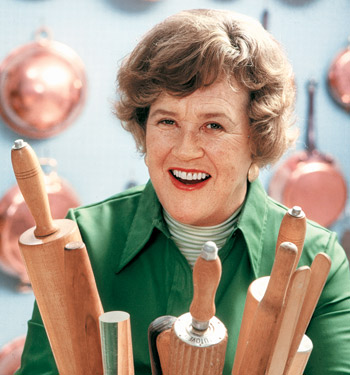
I watched an episode of Martha Stewart's Living last night and one of her guests was Julie Powell author of Julie & Julia. Julie's book chronicles her experiences while cooking every recipe in Louisette Berthole, Simone Beck and Julia Child's classic book Mastering the Art of French Cuisine. Quite a feat and written with humor and wit. Her project was actually first chronicled on her food blog The Julie/Julia Project which she started in August 2002. On the show she cooked a mouthwatering Beef Bourginogne that made me want to go straight to the grocery for ingredients. Only I couldn't because it was late at night. Why can't we have a 24-hour grocery??

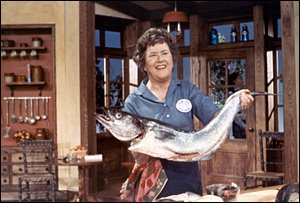
Julia Child brought the art of cooking and eating to the American household. Her enthusiasm and dedication to good food has made her an American icon and she is known to every cook worth his salt. On the show, Martha revealed that she too had cooked every recipe on the book and that is how she learned to cook well. I would think anyone who wants to learn how to be a chef would learn by doing what Julie and Martha did in place of going to culinary school.

I own a 1964 edition of Mastering the Art of French Cuisine which belonged to my great-grandmother whom I was named after. My great-grandmother is a cooking legend in my clan and this book was one of two books that she owned (the other was The Joy of Cooking). In her memory and for the benefit of anyone in her family who want to recreate the food, cakes, pastries and preserves she served in her summer house in Baguio or her home in San Rafael, Manila my Aunt recopied all her personal recipes and distributed them to all the family members. The only problem is that most of the recipes have no measurements. She died after her third great-grandchild was born. Me being her first great-grandchild. My favorites were esaymadas, guava paste, strawberry jam, mango jam and food for the gods. I remember summers in Bagiuo when I was very young and she would be doing cross-stich in her living room and I would sneak into the pantry and finish all the guava paste. Her ensaymadas would melt in your mouth. When I tried to make it years later, I realized why it was so delicate and melty, it had tons of butter incorporated with flour, much like a puff pastry except it was moist, cheesy and light at the same time. Incredible!


In memory of these two great women whose culinary skills have had a profound influence on me and to Julie who is destined for cooking greatness I will cook the book's recipe for Fish Quenelles in Normandy Sauce Gratinee. Now, I'm off to the grocery.


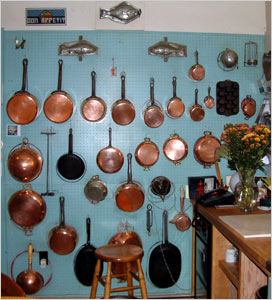
Julia Child's kitchen, the wall used to hang her pots and pans was built for her by her husband 40 years ago. Go here to see more of her kitchen which is on display at the Smithsonian.